Sri Ranganathaswamy Temple
திருவரங்கம் · Thiruvarangam
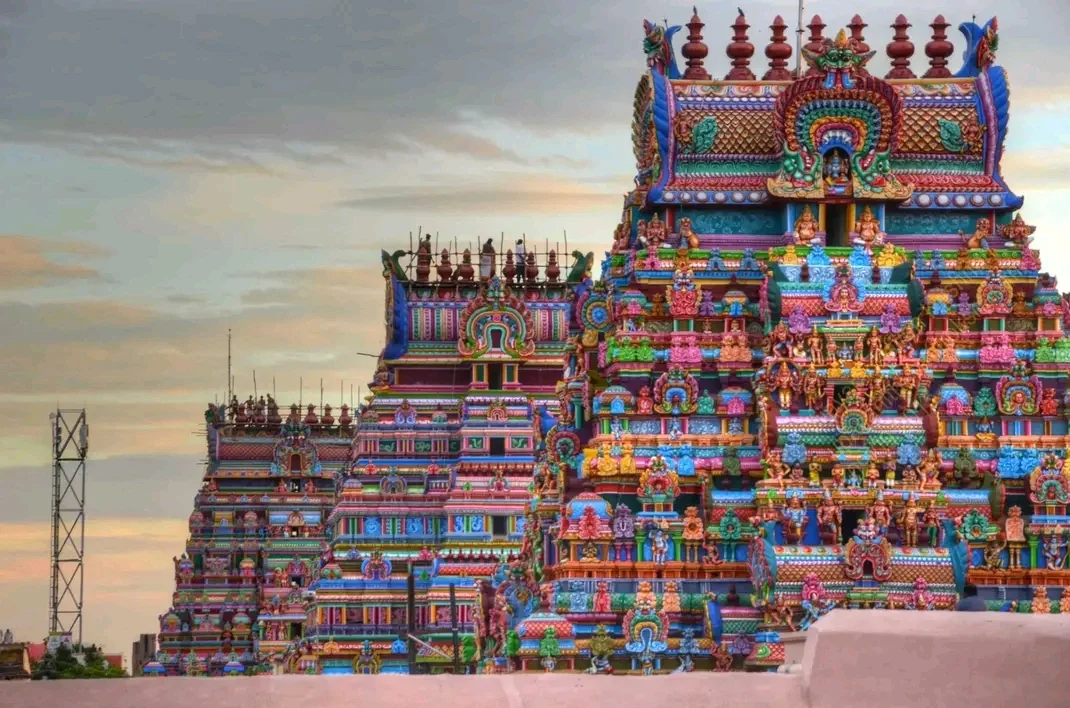
Sri Ranganathaswamy Temple at Srirangam is the foremost of the 108 Divya Desams and is traditionally regarded as the largest functioning Hindu temple complex in the world, spread across an island formed by the Kaveri and Kollidam rivers.
Quick facts
- Perumal
- Ranganathar
- Thayar
- Ranganayaki
- Posture
- reclining
- Facing
- south
- Theertham
- Chandra Pushkarini
- Vimanam
- Pranavakriti Vimanam
- District
- Tiruchirappalli
- State
- Tamil Nadu
- Region
- Chola Nadu
Why Srirangam Is Called Bhoologa Vaikuntham
Srirangam holds a place unlike any other Divya Desam: it is glorified by all twelve Alvars, the only temple among the 108 to receive mangalasasanam from every one of them, and it is traditionally listed first in the order of the Naalayira Divya Prabandham. Devotees and Acharyas call it "Bhoologa Vaikuntam" (Vaikuntham brought down to Earth) and among Sri Vaishnavas the temple is referred to simply as "the Koil," the temple, as if there were no other. The whole town of Srirangam is built as a temple-city, with seven concentric walled enclosures (prakarams) radiating out from the sanctum, so that the act of walking toward Ranganatha is itself a journey through the layers of the sacred city.
Srirangam's place in Sri Vaishnava history is inseparable from the theologian-saint Ramanuja, who made the temple his monastic home in the 11th century, organized its rituals and administration, and wrote his commentaries on the Brahma Sutra while living within its walls. Ramanuja's preserved bodily form (thirumeni) is still enshrined and venerated in a dedicated sannidhi inside the temple, making Srirangam not only the first Divya Desam but also the spiritual headquarters from which Sri Vaishnavism organized itself as a living tradition.
From Vibhishana's Legend to Malik Kafur's Raid: Srirangam's Layered History
Temple tradition holds that the Ranganatha idol was first worshipped by Brahma, passed down through the Ikshvaku dynasty to Rama, and given by Rama to Vibhishana as a token of friendship after the Ramayana war. Carrying the idol back to Lanka, Vibhishana is said to have set it down at Srirangam to perform a ritual, after which it could not be lifted again. Ranganatha had chosen to remain, and turned to face south, it is said, so that he could continue to watch over and bless Vibhishana's kingdom.
Separate from the legend, the temple's documented history is unusually long and well recorded: archaeological and inscriptional evidence traces an early shrine here to around the 1st to 3rd century CE under the Uraiyur Cholas, with the site developed further and endowed by a succession of dynasties, the Medieval Cholas, the Pandyas, the Hoysalas, the Vijayanagara emperors and later the Nayaks and Marathas. Well over 800 inscriptions survive on the temple's walls and monuments, recording royal grants, endowments and administrative decisions in Tamil, Sanskrit, Kannada, Telugu, Marathi and Odia, a rare record of continuous patronage across nearly a thousand years.
That continuity was violently interrupted in 1311, when forces under Malik Kafur, a general of the Delhi Sultanate, raided the temple as part of a wider campaign into the Tamil country; contemporary Persian chronicles describe the plunder of a great "golden temple" on the Kaveri, widely identified with Srirangam. Tradition holds that the utsava (festival) idol was moved and hidden for safety during this period of turmoil before eventually being restored to the sanctum. The temple's recovery and much of its present grandeur (including the great gopurams) are credited to the patronage of the Vijayanagara empire in the centuries that followed.
Inside the World's Largest Functioning Temple Complex
Srirangam is traditionally described as the largest functioning Hindu temple complex in the world, covering roughly 156 acres within seven concentric prakarams (walled enclosures) and twenty-one gopurams (gateway towers), with the towers generally decreasing in height and ornamentation as they approach the innermost, most sacred enclosure, the reverse of what a first-time visitor often expects. Ranganatha reclines in the innermost sanctum beneath the Pranavakriti Vimanam, a tower said to be shaped in the form of the sacred syllable Om (Pranava).
The temple's outermost tower, the Rajagopuram, is among its most striking features: construction began under the Vijayanagara emperor Achyuta Deva Raya in the 16th century but was left unfinished for roughly four centuries after his death, standing only partially built for generations. It was finally completed in 1987 under the 44th Jeeyar of the Ahobila Mutt, reaching a height of about 73 metres (239 feet), making it one of the tallest temple gopurams in Asia and, for many visitors arriving from Trichy, the very first sight of the temple long before they reach its gates.
Vaikunta Ekadashi: The 21-Day Festival at Srirangam
The temple's best-known festival is the twenty-one day Vaikunta Ekadashi celebration, held in the Tamil month of Margazhi (December–January), during which devotees pass through the ceremonial "Paramapada Vasal" (the gateway to Vaikuntham) in a darshan believed to confer the same merit as reaching Vishnu's heavenly abode itself. The festival period includes extended recitation (Adhyayanotsavam) of the Naalayira Divya Prabandham within the temple, connecting the event directly back to the Alvars whose verses first glorified this and every other Divya Desam.
Beyond Vaikunta Ekadashi, the temple observes an annual Brahmotsavam and a full ritual calendar tied to the Tamil festival year; because Srirangam is administered as a major temple with a large and complex liturgical tradition, its festival calendar is unusually extensive compared with most other Divya Desams.
Daily Rituals and Darshan at Ranganathaswamy Temple
Daily worship at Srirangam follows the elaborate multiple-time schedule characteristic of a major Sri Vaishnava temple (typically structured around a sequence of morning, midday, evening and night poojas rather than a single continuous darshan window) with additional special darshans, processions and abhishekams added during festival periods. Because of the temple's size, a full visit covering the principal shrines within its seven prakarams takes considerably longer than at a typical Divya Desam.
Timings
- Morning
- 06:00–12:00
- Evening
- 16:00–20:30
Timings may change on festival days. Devotees should verify locally before travel.
Glorified By
This temple was glorified in verse (mangalasasanam) by Periyalvar, Andal, Kulasekara Alvar, Thirumazhisai Alvar, Thondaradippodi Alvar, Thiruppaan Alvar, Thirumangai Alvar, Poigai Alvar, Bhoothathalvar, Peyalvar, Nammalvar.
Planning Your Trip to Srirangam Temple
How to reach
Srirangam sits on an island formed by the Kaveri and Kollidam rivers, on the immediate outskirts of Tiruchirappalli (Trichy). Trichy has its own domestic airport and is a major railway junction on the southern network, with frequent trains and buses from Chennai, Madurai, Chennai, Coimbatore and other major South Indian cities; Srirangam itself is a short auto or bus ride from the Trichy railway station and bus stand.
Where to stay
Srirangam town has a range of pilgrim lodges and mid-range hotels within walking distance of the temple, catering specifically to visiting devotees. Tiruchirappalli, just across the river, is a full-sized city with a much wider range of accommodation from budget to upscale, making it the practical base for most travellers arriving by air or rail.
Best time to visit
The Vaikunta Ekadashi period in December–January is Srirangam's most significant but also most crowded season, when the Paramapada Vasal darshan draws very large numbers of pilgrims from across South India. Visitors who prefer a quieter experience of the temple's architecture and daily rituals generally find weekday mornings outside festival season considerably calmer, with shorter queues for the main sanctum.
Where to go next
The nearest Divya Desam is Thirukkoli at Uraiyur (about 5.2 km away), birthplace of the Alvar-saint Thiruppaan Alvar, followed by Thiruvellarai (about 11.1 km), both comfortably combined with a Srirangam visit on the same trip, along with the wider Trichy-Srirangam cluster of five Divya Desams.
Location
Open in Google MapsThis Divya Desam is one of 25 where Perumal appears in reclining posture.
Periyalvar sang mangalasasanam here, one of 15 Divya Desams glorified by Periyalvar.
Frequently Asked Questions
Why does Ranganatha face south at Srirangam?
Temple tradition holds that Vishnu chose to face south at Srirangam to watch over and bless his devotee Vibhishana's kingdom of Lanka.
Is Srirangam the largest Hindu temple?
Srirangam is traditionally described as the largest functioning Hindu temple complex in the world by area, covering around 156 acres.
What are the temple timings at Sri Ranganathaswamy Temple?
The temple is typically open 06:00–12:00 and 16:00–20:30. Timings may change on festival days. Devotees should verify locally before travel.
Is there a dress code?
Most Sri Vaishnava temples expect traditional attire: dhoti/veshti for men and saree or salwar for women is customary. Dress codes vary by temple and can change, so it is worth checking locally or with the temple administration before visiting.
Is darshan free or ticketed?
Darshan arrangements and any special ticket options can change over time. Contact the temple or check official sources for current details before travelling.
How long does a visit typically take?
This varies with crowds and the day: a simple darshan can take under an hour, while festival days or peak season can mean a much longer wait. Plan for extra time if visiting during a major festival.
Which other Divya Desam can I combine with this visit?
Thirukkoli, about 5.2 km away, is the closest and is commonly combined with a visit here.
Nearby Divya Desams
Divya Desam #2
ThirukkoliAzhagiya Manavala Perumal
Uraiyur, Tamil Nadu
Divya Desam #4
ThiruvellaraiPundarikaksha Perumal
Thiruvellarai, Tamil Nadu
Divya Desam #6
ThiruappakkudathaanAppakudathaan Perumal
Koviladi, Tamil Nadu
Also glorified by Periyalvar
Other reclining Divya Desams
Last verified: July 2026
Sources: Wikipedia: Divya Desam · T. Sampath Kumaran: Guide to 108 Divya Desams · Content verified for publication
Ask a Question / Share Your Experience
No comments yet: be the first to share your experience of this temple.
Leave a comment